Nepal Flash Flood Disaster a Wake-Up Call for Kashmir: Why GLOF and Glacier Collapse Risks Can No Longer Be Ignored
By: Javid Amin | 30 August 2026
What happened along the Nepal-Tibet border was not simply another mountain disaster. It was a warning from a rapidly changing Himalaya — and Kashmir has reason to listen carefully.
The Himalayas have always been unpredictable. Landslides, avalanches, cloudbursts and flash floods are woven into the geography of the world’s youngest mountain range. But the catastrophe unfolding after the August 26 disaster along the Nepal-Tibet border has demonstrated something more troubling: in a warming and increasingly unstable Himalayan environment, a disaster can begin high above human settlements and become deadly within minutes.
The latest verified figures underline the scale of the tragedy. Nepal’s Foreign Ministry said on August 30 that 734 bodies had been recovered and around 2,498 people remained unaccounted for, while more than 8,000 people had been rescued. The ministry stressed that the figures were still changing as search and verification operations continued.
Across the border in Tibet, Chinese authorities separately reported missing foreign nationals, including 49 Indians among 261 foreigners from 23 countries. However, these numbers refer specifically to people missing on the Tibetan side and should not be confused with Nepal’s broader casualty and missing-person figures.
That distinction matters.
Early reports described the disaster in different ways — as a glacial collapse, an ice-rock avalanche and, in some initial accounts, a possible glacial lake outburst flood. Scientists are still reconstructing the precise sequence. What is increasingly clear, however, is that the event was part of a dangerous chain reaction involving high-altitude ice, rock, debris and water.
And that has direct relevance for Kashmir.
A recent scientific assessment of the Kashmir Himalaya found that five glacial lakes have very high susceptibility to potential glacial lake outburst floods, with thousands of buildings, bridges, roads and at least one hydropower project potentially exposed downstream.
The lesson from Nepal is therefore larger than one disaster.
Kashmir does not need an exact replica of Nepal’s catastrophe to face devastation. It only needs one unstable lake, collapsing slope, ice avalanche or cascading debris flow in the wrong valley at the wrong time.
The Nepal Disaster: A Catastrophe That Began in the High Himalayas
The disaster struck the Himalayan border region on August 26, triggering devastating flooding through valleys connected to the Nepal-China frontier.
Initial confusion over what exactly caused the catastrophe reflected the difficulty of investigating disasters in remote high-altitude terrain. Satellite observations and geological assessments pointed toward a major collapse involving ice and rock, which generated an enormous debris flow and flood downstream.
Reuters reported that the disaster was linked to a glacier collapse that sent torrents of rock, mud and debris through Himalayan river systems, devastating settlements and infrastructure.
Associated Press reported that authorities and experts believed a glacial avalanche played a central role, with the resulting flood moving with extraordinary speed through narrow valleys.
The scale of destruction was immense.
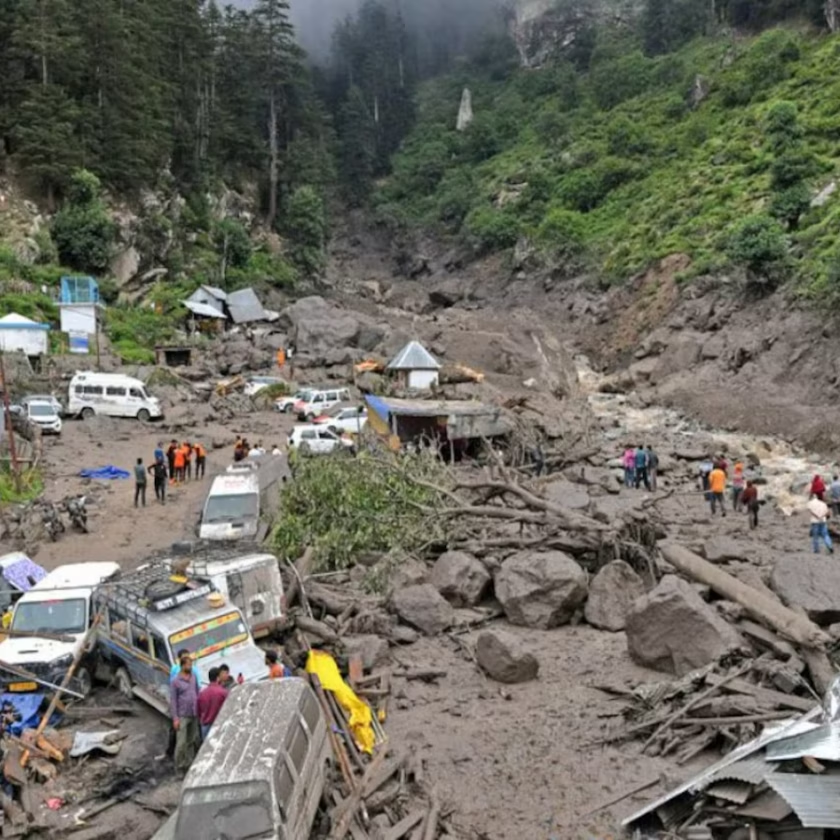
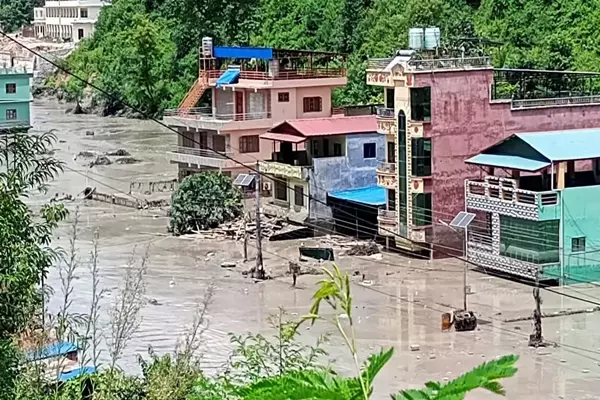
Roads disappeared beneath debris. Bridges were swept away. Hydropower infrastructure was damaged. Border facilities were devastated. Rescue teams struggled to reach isolated communities because the same geography that makes the Himalayas spectacular also makes them brutally difficult during emergencies.
By August 30, Nepal’s Foreign Ministry said around 19,000 security personnel and 16 helicopters had been mobilised for rescue operations. International tunnel-rescue specialists from India, China and South Korea were also assisting in efforts to reach people trapped in hydropower tunnels.
This was not simply a flood.
It was a cascading mountain disaster.
And that distinction is important for Kashmir.
Fact Check: Was This a GLOF?
One of the biggest questions surrounding the Nepal-Tibet disaster is whether it should be described as a classic Glacial Lake Outburst Flood, or GLOF.
The answer, based on the available reporting, is more complicated than some early summaries suggested.
A traditional GLOF occurs when a glacial lake — often held back by unstable moraine, ice or geological material — suddenly breaches and releases a massive volume of water downstream.
But Himalayan disasters do not always fit neatly into one category.
An ice avalanche can crash into a valley. A rock collapse can block a river and create a temporary lake. A debris avalanche can mobilise meltwater. A landslide dam can later breach. One event can trigger another.
That is why experts increasingly speak about cascading hazards rather than treating every disaster as a single isolated event.
ICIMOD, the International Centre for Integrated Mountain Development, notes that glacial hazards can be triggered by several mechanisms, including slope failures, avalanches, displacement waves and instability in moraine dams. As glaciers retreat and lakes expand, the number of potential hazard pathways can increase.
The Nepal disaster reinforces an uncomfortable reality:
The Himalayas do not always give disasters a single cause.
Climate change may increase instability, but local geology, steep slopes, permafrost degradation, glacier retreat, heavy rainfall and infrastructure exposure can all combine to transform a natural event into a catastrophe.
That broader understanding is especially important for Kashmir.
Kashmir’s Hidden Himalayan Risk
For years, Kashmir’s climate conversation has focused largely on changing snowfall, shrinking glaciers, heatwaves, floods and erratic rainfall.
But high in the mountains, another threat is quietly developing.
Glacial lakes.
These lakes form as glaciers retreat and meltwater accumulates behind natural barriers. Some remain stable. Others can become increasingly vulnerable because of expanding water volumes, weak moraine dams, unstable surrounding slopes or the possibility of avalanches entering the lake.
A major scientific study published in the Journal of Glaciology assessed 155 glacial lakes across the Kashmir Himalaya using satellite observations and hydro-geomorphic indicators.
The study found that the area of ice-contact proglacial lakes had increased by 26% between 1992 and 2024. It identified five lakes with very high susceptibility to potential GLOFs.
The five lakes identified as highly susceptible include:
- Bramsar
- Chirsar
- Nundkol
- Gangabal
- Bhagsar
The research warned that potential downstream impacts could extend to several thousand buildings, major bridges, roads and a hydroelectric project.
This is the point where the Nepal tragedy becomes deeply relevant.
The danger is not limited to the lake itself.
A high-altitude lake may be far from any village. But once water and debris enter a narrow mountain valley, the destructive force can travel rapidly downstream.
A remote hazard can become an urban or infrastructure disaster.
Five High-Risk Lakes Do Not Mean Five Immediate Disasters — But the Warning Is Serious
There is an important nuance that should not be ignored.
“Very high susceptibility” does not automatically mean that a lake will burst tomorrow.
Hazard assessment is not the same as predicting the exact date of a disaster.
The Kashmir study identifies lakes that require closer scientific attention because their physical characteristics and downstream exposure create potentially serious consequences.
That is precisely why monitoring matters.
A major scientific risk assessment of the Indian Himalayas has previously warned that Jammu and Kashmir faces significant GLOF exposure because of the interaction between glacial hazards and downstream populations, roads and infrastructure.
In other words, the risk is not simply about how many glacial lakes exist.
It is about three questions:
- How unstable is the lake or surrounding terrain?
- What could trigger an outburst or collapse?
- What lies downstream?
A small event in an isolated valley may have limited consequences.
A similar event above a populated settlement, highway, hydropower project or tourism route could become catastrophic.
Nepal Shows Why Kashmir Must Think Beyond GLOFs
Perhaps the most important lesson from the latest Himalayan disaster is that Kashmir’s preparedness should not focus narrowly on one threat.
A disaster does not need to begin with a lake breach.
It could begin with:
- An ice avalanche
- A glacier collapse
- A rockslide into a glacial lake
- A sudden moraine failure
- A cloudburst
- A landslide blocking a river
- The collapse of a temporary natural dam
- Permafrost degradation destabilising mountain slopes
These hazards can interact.
That is the frightening part.
A warming mountain landscape is not simply producing more water. It may also be altering the physical stability of ice, rock and soil.
ICIMOD has repeatedly warned that glacier retreat and the expansion of glacial lakes are changing hazard conditions across the Hindu Kush Himalaya. It also stresses that effective risk reduction requires both satellite monitoring and detailed field investigation.
For Kashmir, this means the Nepal disaster should not be reduced to a simple headline: “Beware of GLOFs.”
The deeper warning is:
Mountain hazards are becoming more complex, and disaster planning must become more sophisticated.
Tourism Could Be Kashmir’s Weakest Link
Tourism is one of Kashmir’s economic lifelines.
Thousands of visitors travel annually to mountain destinations, alpine lakes, pilgrimage routes and trekking trails. Many of these journeys pass through remote valleys where communication networks can be weak and evacuation routes limited.
The Nepal disaster exposed exactly how vulnerable tourism can become during sudden mountain emergencies.
Among those caught in the catastrophe were foreign tourists, trekkers and pilgrims. On the Tibetan side alone, Chinese authorities reported 261 foreign nationals missing at one stage of the rescue operation, including 49 Indians.
Numbers related to missing foreigners have varied across official jurisdictions and over time, reflecting the difficulty of reconciling tourist lists, border records, rescue data and family reports.
That confusion itself offers another lesson.
When a disaster strikes a remote mountain corridor, authorities may not immediately know:
- Who entered the area
- Who left safely
- Who changed routes
- Who is stranded
- Who is genuinely missing
Kashmir’s trekking and pilgrimage management systems need to take this seriously.
Remote tourism cannot rely solely on mobile phones and informal registration.
In vulnerable areas, authorities should consider stronger systems for:
- Digital trek registration
- Route-wise visitor databases
- Satellite communication backups
- Mandatory weather and hazard briefings
- Emergency check-in protocols
- Trained mountain guides
- Temporary closure mechanisms during high-risk periods
Tourists often assume that danger comes with warning.
In the Himalayas, it may not.
Climate Change Is Raising the Stakes — But It Is Not the Only Cause
It is tempting to describe every Himalayan disaster as a direct consequence of climate change.
The reality is more complicated.
Climate change does not physically cause every landslide, glacier collapse or flood by itself. But rising temperatures can alter the background conditions in which these events occur.
Warmer conditions can accelerate glacier melt.
Retreating glaciers can leave unstable slopes exposed.
Glacial lakes can expand.
Permafrost can weaken.
Snow and ice conditions can change.
Heavy rainfall patterns can become more intense and unpredictable.
All of this creates a more dynamic mountain environment.
The scientific literature on the Hindu Kush Himalaya has consistently warned that glacier retreat is contributing to the formation and growth of glacial lakes, potentially increasing future flood hazards in some regions.
But there is another uncomfortable factor.
Human development can increase exposure.
Roads are being cut into fragile slopes. Hydropower projects are expanding through mountain valleys. Hotels and settlements are growing. Tourism infrastructure is reaching increasingly remote locations.
Climate hazards become disasters when vulnerable people and infrastructure lie in their path.
That is why Kashmir’s environmental challenge is not only about saving glaciers.
It is also about managing development intelligently.
Urbanisation and Infrastructure Can Turn a Natural Hazard Into a Human Disaster
A glacial lake may burst in an uninhabited valley with limited consequences.
The same flood entering a developed corridor can destroy:
- Bridges
- Roads
- Power stations
- Hotels
- Villages
- Telecommunications networks
- Water supply systems
This is particularly relevant for Jammu and Kashmir, where road expansion, hydropower infrastructure and tourism development increasingly intersect with fragile Himalayan landscapes.
The recent Kashmir study estimated that a potential outburst involving the most susceptible lakes could threaten around 2,704 buildings, 15 major bridges, road sections and a hydropower project.
That figure transforms the debate.
GLOF risk is not merely an environmental issue.
It is an issue of:
- Infrastructure planning
- Tourism management
- Public safety
- Energy security
- Climate adaptation
- Disaster governance
And increasingly, economic planning.
Is Kashmir Prepared?
There has been progress.
Jammu and Kashmir’s disaster management system has increasingly recognised GLOF hazards. Kishtwar district, for example, has published a dedicated Glacial Lake Outburst Flood Risk Management Plan, indicating that the threat is now formally part of local disaster planning.
But preparedness cannot remain a document sitting on a government website.
The real test is what happens in the first minutes after an alert.
Can a village be warned?
Can people move to safe ground?
Will communication networks function?
Do residents know evacuation routes?
Can tourists be accounted for?
Can roads remain open long enough for rescue teams?
Are hospitals prepared?
These are operational questions.
And Nepal’s tragedy demonstrates why they matter.
A sophisticated satellite image may identify a dangerous lake.
But a satellite image alone cannot evacuate a village.
What Kashmir Must Do Before the Next Himalayan Disaster
1. Move From Mapping to Real-Time Monitoring
Identifying high-risk lakes is only the first stage.
The most vulnerable locations should be continuously monitored using a combination of:
- Satellite imagery
- Automated weather stations
- Water-level sensors
- Remote cameras
- Ground-based instruments
- Glacier movement observations
Monitoring should also extend beyond lakes to unstable slopes and glacier fronts.
The Nepal disaster has shown that a catastrophic flood can emerge from an ice-rock collapse rather than a traditional lake breach.
2. Build Reliable Early Warning Systems
Early warning systems should connect scientists directly with communities.
An alert that remains inside a government control room is of limited use.
High-risk valleys need systems capable of reaching people through:
- Mobile alerts
- Sirens
- Radio communication
- Satellite messaging
- Local volunteers
- Police and disaster response networks
Warnings must also be understandable.
A technical message about “hydrological anomalies” may mean little to a family living downstream.
The warning should answer one simple question:
What should people do now?
3. Conduct Disaster Drills in Vulnerable Villages
Preparedness cannot begin when floodwater is already approaching.
Communities in vulnerable valleys should participate in regular evacuation drills.
Children should know safe routes.
Schools should have emergency plans.
Village committees should identify elderly and disabled residents who may need assistance.
Local drivers should know alternative evacuation routes.
Tourism operators should have emergency responsibilities.
Disaster preparedness must become part of everyday community resilience.
4. Create Mandatory Safety Protocols for Trekkers and Pilgrims
Mountain tourism has changed.
The old model of simply allowing visitors to enter remote regions and trusting them to return safely is increasingly inadequate.
Authorities should consider:
- Mandatory registration for high-altitude routes
- Real-time weather and hazard advisories
- Emergency contact verification
- GPS-based trekking permits where appropriate
- Restrictions during extreme weather alerts
- Compulsory local guides in high-risk zones
- Better coordination between tourism and disaster authorities
The Nepal disaster demonstrated how difficult it can become to account for foreign travellers once roads, bridges and communications collapse.
Kashmir should learn before facing a similar emergency.
5. Protect Natural Buffers and Regulate Construction
Deforestation and uncontrolled slope modification can worsen the consequences of flooding and landslides.
Mountain ecosystems are not obstacles to development.
They are part of the region’s natural defence system.
Construction in flood pathways, unstable slopes and environmentally sensitive zones must be assessed with far greater caution.
The question should no longer be:
“Can we build here?”
It should be:
“What happens here when the mountain fails?”
6. Strengthen Himalayan Cooperation
The Himalayas do not recognise political borders.
Glaciers, rivers, avalanches and floods move across landscapes that connect multiple countries.
India, Nepal, China, Bhutan and Pakistan all face aspects of Himalayan climate and disaster risk.
Scientific cooperation can be difficult because of geopolitics.
But hazards do not wait for diplomatic agreements.
Regional cooperation should include:
- Satellite data sharing
- Glacial lake inventories
- Joint research
- Flood forecasting
- Scientific exchanges
- Rescue coordination
- Cross-border emergency communication
ICIMOD has long emphasised the importance of regional knowledge-sharing because Himalayan hazards are often transboundary in nature.
The Nepal disaster makes that argument even stronger.
The Most Important Lesson: Kashmir Must Prepare for Cascading Disasters
The greatest mistake would be to view Nepal’s catastrophe as a distant tragedy with no direct connection to Kashmir.
The landscapes are different.
The valleys are different.
The rivers are different.
But the underlying challenge is strikingly similar.
A rapidly changing cryosphere.
Retreating glaciers.
Growing glacial lakes.
Unstable high-altitude terrain.
Expanding infrastructure.
Growing tourism.
Communities living downstream.
The danger lies not only in one specific type of disaster.
It lies in the interaction between them.
A glacier collapse can trigger a debris flow.
A debris flow can block a river.
A blocked river can form a temporary lake.
A temporary lake can breach.
The flood can destroy bridges.
Destroyed bridges can isolate communities.
Isolation can delay rescue.
This is how a mountain hazard becomes a humanitarian catastrophe.
A Wake-Up Call Before Kashmir Faces Its Own Test
The Nepal-Tibet disaster is still unfolding. The death toll and missing-person figures continue to change as rescue teams reach previously inaccessible areas.
That uncertainty should encourage caution in reporting.
But uncertainty about the final numbers does not change the larger message.
The Himalayas are entering an era in which old assumptions about stability can no longer be taken for granted.
Kashmir already knows the destructive power of extreme weather and flooding. The growing scientific evidence around vulnerable glacial lakes adds another layer to that risk.
The warning signs are visible.
Five lakes in the Kashmir Himalaya have been classified as having very high susceptibility to potential GLOFs. Scientific research has identified thousands of downstream structures and critical infrastructure that could be exposed. The region’s own disaster authorities are now developing specialised risk-management plans.
The question is no longer whether Kashmir should prepare.
It is whether preparation will happen fast enough.
Nepal’s tragedy should not be remembered only through its horrifying casualty figures, missing tourists and destroyed infrastructure.
It should also force Himalayan governments to ask a harder question:
Are we studying disasters after they happen, or preparing for them before they begin?
For Kashmir, the answer could one day determine whether a mountain flood becomes a manageable emergency — or a catastrophe measured in hundreds of lives.
The Himalayas have sent the warning.
This time, the warning came from Nepal.
The next one may not be so far away.